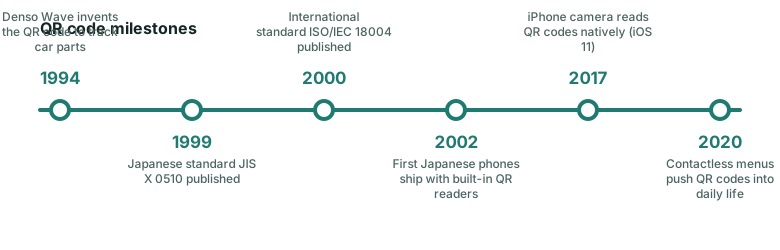
Denso Wave, a Toyota supplier, invented the QR code in 1994 to track car parts. Its designers chose an open approach by not enforcing their patent, the format became an ISO standard in 2000, Japanese phones began reading it in the early 2000s, and iPhone cameras read it natively from 2017.
1994: a factory problem
In the early 1990s, automotive suppliers tracked parts with ordinary one-dimensional barcodes. A single component could need several barcodes to carry all the information, and each one had to be scanned separately. A team at Denso Wave led by Masahiro Hara set out to create a code that held more data, was read quickly from any direction, and survived the dirt of a factory floor. “QR” stands for quick response.
Why the corner squares look the way they do
The team needed a pattern that a scanner could find fast and rarely confuse with ordinary print. They surveyed which ratios of black and white appear in printed materials and chose the one that occurs least often: 1:1:3:1:1. That ratio is the finder pattern, the three large squares in the corners. A scanner can look for it along any line through the code, which is why it works at any rotation. Hara has also described being inspired by the black and white stones of the board game Go when thinking about a grid of modules.
An open standard by choice
Denso Wave holds patents on the technology, but the company has said it will not exercise its rights for codes built to the published standards. That decision let anyone create and read QR codes without paying a licence, and it is a big part of why the format spread. The name “QR Code” itself remains a registered trademark of Denso Wave.
Standards: 1990s to 2000
An industry standard followed in the late 1990s and a Japanese standard (JIS X 0510) in 1999. The international standard, ISO/IEC 18004, was first published in 2000 and has been revised since. It defines the 40 versions (21×21 to 177×177 modules), the four error-correction levels and the encoding modes you can see in our capacity guide.
Early 2000s: mobile phones in Japan
From about 2002, Japanese mobile phones began to include QR code readers alongside their cameras. QR codes appeared in magazines, on posters and on business cards in Japan years before phones elsewhere supported them, which turned the format from an industrial tool into a consumer one.
2010s: the app era
Outside Japan, using a QR code meant installing a scanner app, which limited use. Adoption was patchy: many campaigns put codes on ads that people could not easily scan. A significant change came in 2017, when iPhone cameras with iOS 11 began to read QR codes directly, and Android phones increasingly offered built-in scanning through their camera or Google Lens.
2020: menus and payments
Contactless menus during the pandemic put QR codes in front of almost everyone. Many venues kept them afterwards because they are cheaper to update than printed menus; see our menu guide. Payments, tickets and boarding passes also moved to QR codes in many places. The rise in use brought a rise in abuse, covered in our security guide.
What stayed the same
The core design from 1994 is still what you scan today: finder patterns, timing patterns, versions and Reed–Solomon error correction, described step by step in how a QR code works. That stability, plus openness, is why a code printed years ago can still be read by a brand-new phone.
Frequently asked questions
Who owns the QR code patent?
Denso Wave owns the patents. It has stated that it will not exercise them for codes that follow the published standards, which is why anyone can make and read them for free.
Is it “QR code” or “QR Code”?
“QR Code” with capitals is the registered trademark. In everyday writing, “QR code” is widely used for the technology in general.
Why did QR codes become common so late?
Two things changed: built-in camera scanning, which reached iPhones with iOS 11 in 2017 and spread across Android, and the 2020 shift to contactless menus and payments, which put codes in front of almost everyone.
Try it: QR Code Generator — Create QR codes for links, text, Wi-Fi, contacts, email, phone and SMS. Download PNG or SVG.
Keep reading
Our guides give general information based on QR specifications, calculations and worked examples. Results depend on your printer, materials and devices, so always test a real print. See our editorial policy.